
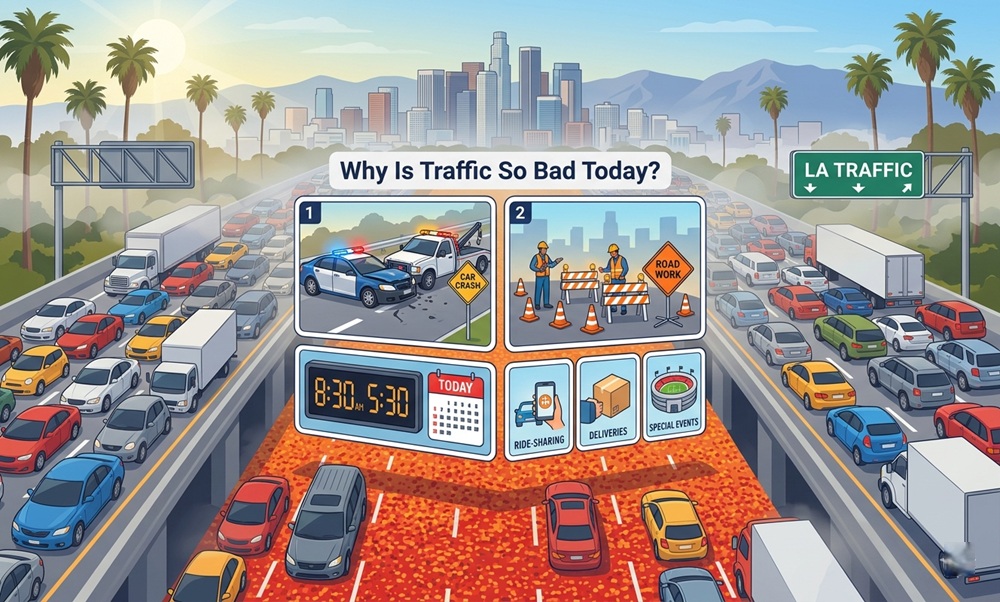

Los Angeles traffic is legendary — not in a good way. Locals joke that there are only two times in LA: traffic and worse traffic. But there’s a real reason the city consistently ranks among the most congested in the world, and understanding it can help you actually navigate it better.
Whether you’re a new resident or a lifelong Angeleno, here’s why LA traffic is what it is — and what strategies genuinely help.
Why Is Traffic So Bad in Los Angeles?
1. Car-Dependent Infrastructure
Unlike New York or Chicago, Los Angeles was built around the car. Suburban sprawl expanded faster than public transit infrastructure could keep up, meaning the overwhelming majority of LA’s 4+ million residents drive to work. There simply aren’t enough train lines and bus routes to move people efficiently without cars.
2. Population and Job Density Mismatch
Many LA residents live in the Valley, South Bay, or Inland Empire and commute into West LA, Century City, or Downtown. This creates long, one-directional commute flows with no good transit alternatives. Adding more lanes doesn’t help — a phenomenon called induced demand means that new lanes fill with new drivers almost immediately.
3. The “Sig-Alert” Problem
LA’s freeway network has no true redundancy. When an accident closes even one lane on the 405 or the 101, there’s often no viable alternate route that doesn’t lead directly into another bottleneck. The system was designed at capacity — it has no slack.
4. Weather Events and Special Events
Counterintuitively, light rain in LA creates disproportionate slowdowns because many drivers aren’t accustomed to wet roads. Add in Dodger games, concerts at the Forum, movie premieres, or major protests, and traffic events compound.
Real Strategies to Deal With LA Traffic
- Shift your commute by 30-45 minutes. Leaving at 6:30 AM instead of 7:30 AM on the 405 can cut commute time by 20-40 minutes — every single day.
- Use Waze for real-time alternatives. Waze’s traffic data in LA is exceptional because of its huge user base in the city. It will route you through side streets and neighborhoods that even long-time residents don’t know.
- Work from home on the worst days. Check the LA SigAlert app before committing to a long freeway drive — if there’s a major incident, working from a nearby coffee shop for 2 hours can save you hours.
- Use Metro Rail for specific corridors. The Metro E Line (Expo) from Santa Monica to Downtown and the B Line (Red) from North Hollywood to Union Station are genuinely competitive with driving at peak hours.
- Combine errands strategically. LA’s sprawl makes trip chaining essential. A round trip to run three errands near each other saves far more time than three separate trips.
| Freeway | Worst Hours | Best Alternative |
| I-405 | 7-10 AM, 4-8 PM | Surface streets via Venice Blvd |
| I-101 | 7-9:30 AM, 4-7:30 PM | Sunset Blvd or Metro B Line |
| I-10 | 7-9 AM, 5-8 PM | Olympic/Pico Blvd westbound |
| I-5 | 6-9 AM, 3-7 PM | Adjust departure time by 1 hour |
Pro Tips from Long-Time LA Drivers
- The best time to drive on any LA freeway is Saturday and Sunday before 9 AM — the city feels like a different place
- “Surface street” isn’t always slower — Sepulveda south of the 405 is often faster than the freeway during peak backups
- Build “buffer time” into your calendar for any appointment between 5 PM and 7 PM — things go wrong in LA traffic regularly enough that padding is essential
Common Mistakes to Avoid
- Trusting Google Maps exclusively — Waze’s crowd-sourced data is more current for LA-specific conditions
- Taking the freeway for trips under 5 miles — in LA, surface streets are almost always faster for short distances
- Planning meetings at 5 PM in different parts of the city — build 30-45 minute buffers between appointments in separate neighborhoods
FAQs
What are the worst freeways in Los Angeles?
The 405 through the Sepulveda Pass and the 101 through Hollywood consistently rank as the worst for delay. The 10 westbound toward Santa Monica in the evening is a close third.
Is LA traffic getting better or worse?
Post-pandemic, LA traffic has largely returned to pre-2020 levels and in some corridors has worsened due to population and employment growth in west-side tech hubs.
Does the Metro actually help avoid LA traffic?
For specific corridors, yes. The E Line between Downtown and Santa Monica and the B/D Line from the Valley to Downtown are genuinely competitive with driving during peak hours.
Conclusion
LA traffic is bad because of decades of car-first planning decisions — and there’s no quick fix on the horizon. What you can control is timing, routing, and mindset. Shift your schedule when possible, trust Waze over instinct, and embrace Metro for the corridors where it competes with driving. The city rewards adaptability.


Leave a Comment